Finding the min-norm solution to a linear system of equations.

This example considers the problem of finding the min-L2-norm solution to a system of linear equations. The problem is formulated as a constrained minimization problem:
where \(A\) is a matrix of size \((m, n)\) and \(b\) is a vector of size \((m, 1)\).
This is a well-known convex problem in numerical linear algebra, whose solution is given by the vector \(x^*\) satisfying \(A^{\dagger}b = x^*\), where \(A^{\dagger}\) is the Moore-Penrose pseudo-inverse of \(A\).
Here we analyze this traditional problem under the framework of gradient-based Lagrangian optimization. We allow for the possibility that the system of equations is partially observed at each iteration. That is, we assume that the matrix \(A\) and the vector \(b\) may be sub-sampled at each iteration.
where \(\lambda\) is the vector of Lagrange multipliers, and \(D\) is a stochastic diagonal matrix with \(1\) on the indices corresponding to the observed equations and \(0\) everywhere else.
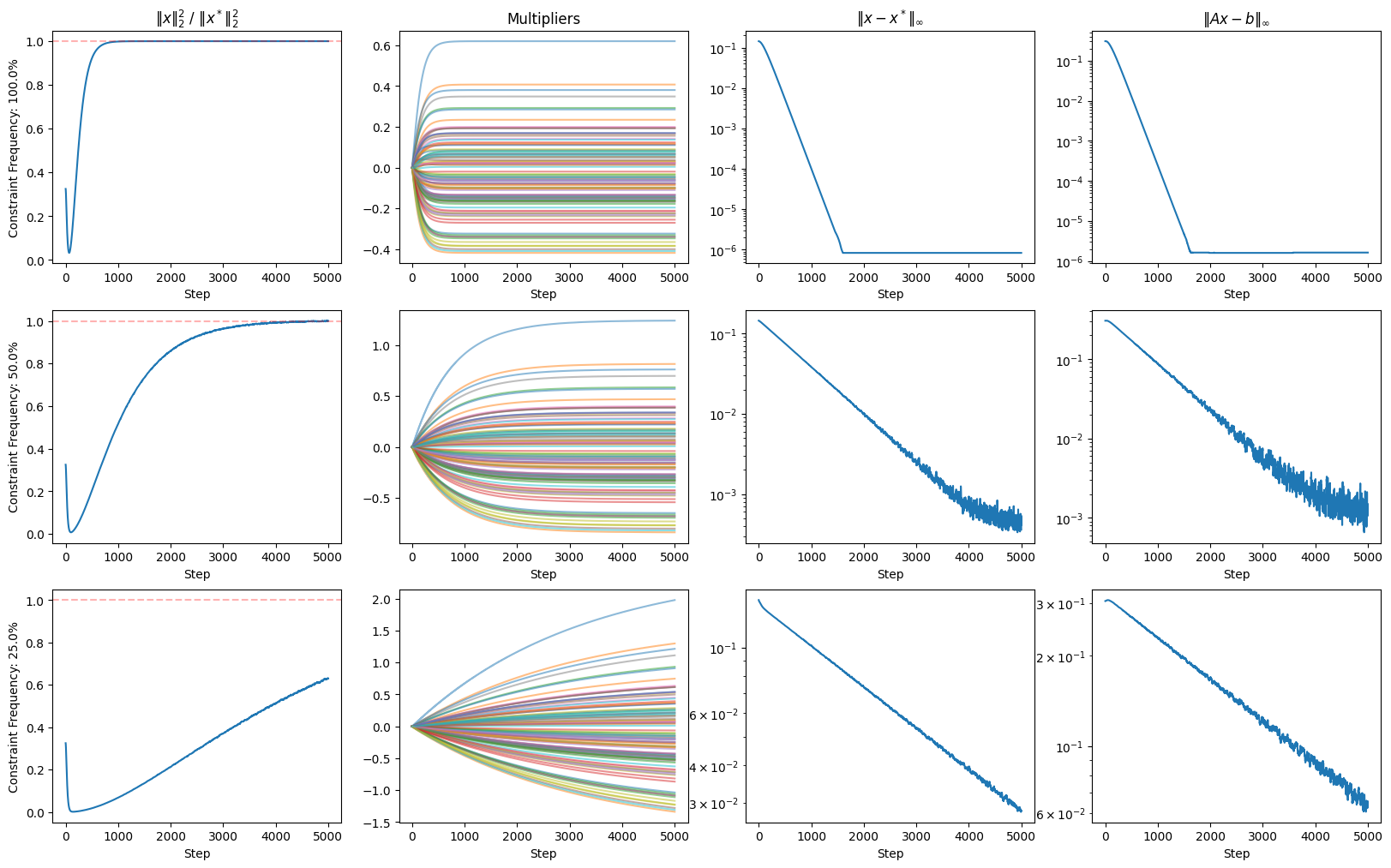
The results below illustrate the influence of the number of observed equations on the convergence of the algorithm.
%%capture
%pip install cooper-optim
import matplotlib.pyplot as plt
import numpy as np
import torch
from torch.utils.data import DataLoader, Dataset
from torch.utils.data.sampler import BatchSampler, RandomSampler

import cooper

DEVICE = torch.device("cuda" if torch.cuda.is_available() else "cpu")


def create_linear_system(num_equations: int, num_variable: int, seed: int = 0):
    """Create a solvable linear system with a well-behaved matrix spectrum.

    Args:
        num_equations: Number of equations in the linear system.
        num_variable: Number of variables in the linear system.
        seed: The seed value to set for random number generation.
    """
    torch.manual_seed(seed=seed)

    # Create a random linear system with 1-singular values
    U, _, V = torch.linalg.svd(torch.randn(num_equations, num_variable))
    S = torch.eye(num_equations, num_variable)
    A = U @ S @ V.T

    # Build a solvable linear system
    b = A @ torch.randn(num_variable, 1)
    b /= torch.linalg.vector_norm(b)

    # Build min-norm solution based on the SVD of A
    x_optim = V @ (S.T @ (U.T @ b))

    # Verify that the analytical solution is sufficiently close numerically
    assert torch.allclose(A @ x_optim, b, atol=1e-5)

    A, b, x_optim = A.to(DEVICE), b.to(DEVICE), x_optim.to(DEVICE)

    return A, b, x_optim


class LinearConstraintDataset(Dataset):
    """Dataset comprising equations in a linear constraint system. This dataset is used
    to sample equations for the equality constraints in the min-norm problem.

    Args:
        A: Matrix of the linear system.
        b: Right-hand side of the linear system.
    """

    def __init__(self, A: torch.Tensor, b: torch.Tensor):
        self.A, self.b = A, b

    def __len__(self):
        return self.A.shape[0]

    def __getitem__(self, index: list[int]) -> tuple[torch.Tensor, torch.Tensor, torch.Tensor]:
        index = torch.tensor(index)
        return self.A[index], self.b[index], index


def instantiate_dataloader(dataset: Dataset, batch_size: int, seed=0) -> DataLoader:
    # Create a dataloader that samples uniformly with replacement. Pass a generator and a
    # worker_init_fn to ensure reproducibility
    g = torch.Generator()
    g.manual_seed(seed)

    # Create a random sampler and a batch sampler to sample the constraints uniformly with replacement
    random_sampler = RandomSampler(dataset, replacement=False, generator=g)
    batch_sampler = BatchSampler(random_sampler, batch_size=batch_size, drop_last=True)

    return DataLoader(dataset, sampler=batch_sampler, batch_size=None)


class MinNormWithLinearConstraints(cooper.ConstrainedMinimizationProblem):
    """Min-norm problem with linear equality constraints."""

    def __init__(self, num_equations: int) -> None:
        super().__init__()
        # Create a constraint for the equality constraints. We use a sparse constraint
        # to be able to update the multipliers only with the observed constraints (i.e. the
        # ones that are active in the current batch)
        constraint_type = cooper.ConstraintType.EQUALITY
        multiplier = cooper.multipliers.IndexedMultiplier(num_constraints=num_equations, device=DEVICE)
        self.eq_constraint = cooper.Constraint(
            constraint_type=constraint_type, formulation_type=cooper.formulations.Lagrangian, multiplier=multiplier
        )

    def compute_cmp_state(
        self, x: torch.Tensor, sampled_equations: torch.Tensor, sampled_RHS: torch.Tensor, indices: torch.Tensor
    ) -> cooper.CMPState:
        loss = torch.linalg.vector_norm(x) ** 2
        violation = (sampled_equations @ x - sampled_RHS).view(-1)
        constraint_state = cooper.ConstraintState(violation=violation, constraint_features=indices)
        return cooper.CMPState(loss=loss, observed_constraints={self.eq_constraint: constraint_state})


def run_experiment(
    num_equations, num_variables, batch_size, num_steps, primal_lr, dual_lr, data_seed=135, exp_seed=246
):
    # Create a random linear system
    A, b, x_optim = create_linear_system(num_equations, num_variables, seed=data_seed)
    optimal_sq_norm = torch.linalg.vector_norm(x_optim).item() ** 2
    all_indices = torch.arange(num_equations, device=DEVICE)

    torch.manual_seed(seed=exp_seed)
    linear_system_dataset = LinearConstraintDataset(A, b)
    constraint_loader = instantiate_dataloader(dataset=linear_system_dataset, batch_size=batch_size, seed=exp_seed)

    # Define the problem with the constraint
    cmp = MinNormWithLinearConstraints(num_equations=num_equations)

    # Randomly initialize the primal variable and instantiate the optimizers
    x = torch.nn.Parameter(torch.rand(num_variables, 1, device=DEVICE) / np.sqrt(num_variables))

    primal_optimizer = torch.optim.SGD([x], lr=primal_lr, momentum=0.9)
    dual_optimizer = torch.optim.SGD(cmp.dual_parameters(), lr=dual_lr, maximize=True, foreach=False)
    cooper_optimizer = cooper.optim.SimultaneousOptimizer(
        primal_optimizers=primal_optimizer, dual_optimizers=dual_optimizer, cmp=cmp
    )

    state_history = {"step": [], "relative_norm": [], "multipliers": [], "x_gap": [], "max_abs_violation": []}
    step_ix = 0

    while step_ix < num_steps:
        for sampled_equations, sampled_RHS, indices in constraint_loader:
            step_ix += 1

            sampled_equations, sampled_RHS = sampled_equations.to(DEVICE), sampled_RHS.to(DEVICE)
            indices = indices.to(DEVICE)
            compute_cmp_state_kwargs = {
                "x": x,
                "sampled_equations": sampled_equations,
                "sampled_RHS": sampled_RHS,
                "indices": indices,
            }
            _, cmp_state, _, _ = cooper_optimizer.roll(compute_cmp_state_kwargs=compute_cmp_state_kwargs)

            with torch.no_grad():
                full_violation = A @ x - b
                max_abs_violation = torch.linalg.vector_norm(full_violation, ord=np.inf)

            state_history["step"].append(step_ix)
            state_history["relative_norm"].append(cmp_state.loss.item() / optimal_sq_norm)
            state_history["multipliers"].append(cmp.eq_constraint.multiplier(all_indices).cpu().tolist())
            state_history["x_gap"].append(torch.linalg.vector_norm(x - x_optim, ord=np.inf).cpu().item())
            state_history["max_abs_violation"].append(max_abs_violation.cpu().item())

    return state_history


def plot_results(state_histories) -> None:
    _, ax = plt.subplots(len(state_histories), 4, figsize=(20, len(state_histories) * 4))

    for exp_id, (exp_label, state_history) in enumerate(state_histories):
        [ax[exp_id, _].set_xlabel("Step") for _ in range(4)]

        ax[exp_id, 0].set_ylabel(exp_label)

        ax[exp_id, 0].plot(state_history["step"], state_history["relative_norm"])
        ax[exp_id, 0].axhline(1, color="red", linestyle="--", alpha=0.3)

        ax[exp_id, 1].plot(state_history["step"], np.stack(state_history["multipliers"]).squeeze(), alpha=0.5)

        ax[exp_id, 2].plot(state_history["step"], np.stack(state_history["x_gap"]).squeeze())
        ax[exp_id, 2].set_yscale("log")
        ax[exp_id, 2].axhline(0, color="red", linestyle="--", alpha=0.3)

        ax[exp_id, 3].plot(state_history["step"], np.stack(state_history["max_abs_violation"]).squeeze())
        ax[exp_id, 3].set_yscale("log")
        ax[exp_id, 3].axhline(0, color="red", linestyle="--", alpha=0.3)

    ax[0, 0].set_title(r"$\|x\|^2_2 $ / $\|x^*\|^2_2$")
    ax[0, 1].set_title("Multipliers")
    ax[0, 2].set_title(r"$\|x - x^*\|_\infty$")
    ax[0, 3].set_title(r"$\|Ax - b\|_\infty$")

    plt.show()


state_histories = []
num_equations, num_variables = 100, 500
experiment_kwargs = {"num_steps": 5000, "primal_lr": 1e-3, "dual_lr": 1e-2}

for constraint_frequency in [1.0, 0.5, 0.25]:
    batch_size = int(constraint_frequency * num_equations)
    state_history = run_experiment(num_equations, num_variables, batch_size, **experiment_kwargs)
    state_histories.append((f"Constraint Frequency: {constraint_frequency * 100}%", state_history))

plot_results(state_histories)